Skip over navigation
home research portfolio résumé photos reading listening

thoughtcrumbs : may 2004

Cupcakes are so rockstar

A couple of women brought cupcakes to the Decemberists/Long Winters show last week at the Aladdin. John Roderick declared there was nothing more rockstar. Or more Portland. Then, when the requisite jokes about laced baked goods ensued, he asked the women, "You go to Reed, don't you." Later, after he finished songs about unsalted butter and cinnamon, he commented that the tasty cupcakes probably contained both. (But no, being Portland, it was soy margarine.) When the women pleaded for the bassist to eat one, John declared that it couldn't happen, because the bassist was already so cute, and if he were to eat a cupcake, it would certainly make him cuter than John, who just couldn't have that.

Colin Meloy was his usual yummy self, and the sixth member of the Decemberists made its Portland debut: Rachel's new gong. The band played plenty of new material, including one with Colin gingerly attempting the piano (with props to his fifth grade piano teacher), and The Tain, with gusto.

May 29, 2004 : 2:38 PM
: link : 0 comments

Comments

Post a Comment      Hide Comments

Schadenfreude and the "Paula Abduling" of wannabes

I am a bad person. I feel truly guilty for the immense pleasure I get from watching The WB Superstar, a reality talent show in which only the most absurdly untalented have a chance. There's the girl who reads lyrics off her hand, and multiple boys with fashion-orientation issues (including my favorite, Frank, clad in a mesh bra, silver cross, and black stilettos). The judges mock the modestly talented and coddle the hopeless (a practice E! called "Paula Abduling the truly tune-challenged"). Frank was told, "There are two things money can't buy: clear skin and fearlessness. You have both, my friend."
May 26, 2004 : 11:18 AM
: link : 0 comments

Comments

Post a Comment      Hide Comments

Cake and beer

Apparently someone isn't beneath pimping his two free gmail accounts. Bryce and Jeff, I hope you're grateful for the ones I gave you merely because you're brilliant. But I like cake and beer, too.
May 25, 2004 : 7:41 PM
: link : 0 comments

Comments

Post a Comment      Hide Comments

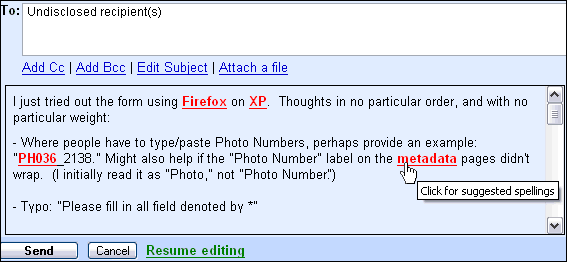
Elegant spellchecker in Gmail

In my previous webmail client, I almost never ran the spellchecker because it was painfully slow. In fact, nearly every basic operation in SquirrelMail required a trip to the server. (Opening spam I thought was a legitimate message was one of the biggest and most time-consuming disappointments I faced every morning.) Google's Gmail has eradicated this delay, through clever CSS and inbox message snippets. One of my favorite features is Gmail's spellchecker. All potential misspellings are highlighted in situ, so tedious serial OKing isn't necessary.

May 17, 2004 : 7:40 PM
: link : 1 comments

Comments

Before moving to Gmail I never used the spell checkers in webmail either. Gmail's is really nice, and I like the label and archive system too! But going back to the spell checker, anyone know how on earth its done? To my mind you either send the message to the server or send the spell checker to the user... But unless I'm wrong neither of these processes are happening! How do they do it?
posted by Anonymous Anonymous : July 06, 2005 11:23 AM : link to this comment  
Post a Comment      Hide Comments

Teitur and Erin McKeown at Lola's Room

Teitur ("tighter," not like the tots) opened for Erin McKeown last night at Lola's Room, and maybe it's just my predilection for unkempt boys who sing lovelorn ballads on acoustic guitars, but I enjoyed him more than Erin. His voice is a bit like Paul Simon's, his melodies like Matt Nathanson's. He commented on the folk festival feel of Portland, going so far as to borrow a pick from someone in the audience. Teitur's from the faro Islands, with which no one in the U.S. is familiar, except nerdy Scrabble players (who, me?) who memorize all of the two-letter words, including "oe," a kind of wind from the Faroes. Erin clearly likes Portland, especially how we refer to ourselves by our airport code (PDX). She played all of her better-known songs, including "Blackbirds" and "Born to Hum" with her intoxicating elixir of a voice. I wish she'd done more of the acoustic folk she used to be known for instead of all the spacey electric pieces, but I guess becoming an indie rock goddess requires a little sacrifice.
6:47 PM
: link : 0 comments

Comments

Post a Comment      Hide Comments

Less sad, more bizarre

The Saddest Music in the World left me wondering whether I actually watched the movie, or if I promptly fell asleep in the theater and dreamed (dog-style, in black and white) the most bizarre fantasy possible. Guy Maddin's unusual film about a music contest in Winnipeg in 1933 was shot in a kind of grayscale tunnel vision, with distorted, blurry edges, similar to the way the main characters monomaniacally pursue their weird goals. Drunken Duncan has a workshop full of prosthetic legs, where he desperately concocts a glass pair filled with frothy ale to be worn by the beer baroness whose legs he accidentally amputated years ago. And the hypochondriac Roderick, miserably searching for the wife who abandoned him after the death of their son, secreting a jar containing his son's heart preserved in tears. And then there's Chester, debonair ne'er-do-well subverting the contest by recruiting other teams to join his, as they strive to perform the saddest music in the world. Spinal Tap could tell them that it'll be in d minor.
2:16 PM
: link : 0 comments

Comments

Post a Comment      Hide Comments

From the CHI exhibition floor: a multi-player Collapse table

Like Simon on steroids, the collaborative Apart Game Console is an OC button-pusher's dream (other than the germs . . . maybe if it were Windexed regularly?). You stand around a circular platform with four or so other people and play one of eight games (including the one we never ever played at work, Collapse). Lights on the panels "fall" along columns from the center to the edges, and when three of the same color are adjacent, you hit one to clear them from the board. The group garners one score, and (at least the times I played) the reaching got a little friendly as the speed increased. The table can also synthesize rhythms -- each column corresponds to a sound, depending on which panels are lighted.

A review of the table, auto-translated from Dutch to English, contains the following exemplary passages:

Of all genres on the 'computer' we can say with rested heart that the gezelschapspel have flopped most. Does it lie to the direct port of the kitchen table to Windows-bureaublad or is it the concept?
(About the author)
Started with gamen in trainer nappy and probably also this way will finish, including trainer nappy.


May 13, 2004 : 10:45 AM
: link : 0 comments

Comments

Post a Comment      Hide Comments

Windows startup sound

One thing that bugged me at CHI was the frequency of the "Hey! I'm using Windows and starting up my laptop now! Everybody look at me!" chime, especially in otherwise politely quiet sessions. Like the Nokia ring that some of my friends still have on their cells (Hannah!), the Windows startup sound reeks of free advertising. Most likely, many of the guilty parties were borrowing laptops and because volume controls aren't always external or obvious, they were embarrassed for the conference faux pas. But the default settings on a system shouldn't be so poorly designed that they routinely embarrass technical professionals.
May 12, 2004 : 6:31 PM
: link : 0 comments

Comments

Post a Comment      Hide Comments

Take your laptop to the ballgame

San Francisco's SBC Park now has WiFi. It's free this year, and they're planning great features like instant replay and food orders. ("I'm the third blueberry iBook from the end of Section A. Please bring my nachos there.") Evan posted some pics from yesterday's Giants game.
5:59 PM
: link : 0 comments

Comments

Post a Comment      Hide Comments

Web expertise comes from collaboration, not hours

Most web-related experiments I've seen include an initial survey, asking how many hours per week participants spend online, or playing games, or checking email. And other than the most cursory review, these surveys rarely inform the experimental design. For some of their recent studies, the members of the Fidelity Investments Human Interface Design group developed a different kind of survey, asking people to identify the function of common web icons, such as the back button, the shopping cart, and the SSL lock. They later found a strong correlation between web task performance and the survey score, indicating that it was, in fact, a better indicator of web expertise than raw hours online.

So, that much is obvious. However, they further compared "hours" to "expertise" for different age groups and found that older adults who had logged the same amount of time online as younger users still performed worse in web studies. Rather than immediately attributing the difference to motor or cognitive processing issues, they looked at collaborative learning. Office workers and students have ample opportunity to learn web tricks from people around them. (I recently learned Ctrl + Scrolling down on the mouse wheel increases font size.) The older adults in the study reported being more isolated and thus had fewer chances to glean tricks through this "rubbing off."

May 10, 2004 : 7:23 PM
: link : 0 comments

Comments

Post a Comment      Hide Comments

Multiple collections and shared hierarchies

Card sorting is a powerful tool . . . yadda yadda yadda. Card sorting frustrates me, especially when I'm using it to figure out how my users mentally organize something as abstract and gooey as a website. Last year, I ran a series of card sorts with students, librarians, and instructors at the community college library where I work. The shuffling of index cards part was great, especially when people grabbed the magic marker and crossed out some jargony term like "proxy server configuration" and replaced it with something obvious like "read magazine articles online." But I felt like the Hierarchy Nazi by requiring them to put each card in only one pile. (After the first person, I gave in, and let them duplicate cards and put them as many places as they wanted.) And the software I use for rough cluster analysis of card sorts goes kaplooey if someone is audacious enough to want to put the "student computer lab" page under both "computers" and "services for students." Accustoming people to hyperlinking makes defining the "one true home of this webpage" ridiculous.

So I'm delighted with Haystack, even if it's intended for a slightly different purpose: allowing people to sort their personal files (email, to-dos, photos, MP3s) into multiple "collections," regardless of file type and much more flexibly than the strict folder system Windows imposes.

And then, I'd like to use the love child of Haystack and the Document Co-Organization project for my future card sorts. It allows people to construct a hierarchy, share it with a group, and then it generates a consensus hierarchy. Which is exactly what information architecture is about. Can we begin the eugenic software breeding project now?

May 07, 2004 : 10:37 AM
: link : 0 comments

Comments

Post a Comment      Hide Comments

Can you say, "Everybody Loves Raymond"?

NPR's Steve Inskeep asks the obvious question: "When Friends first went on the air and it seemed like an extremely weak sitcom compared compared to the things around it. Over the decade that followed, did it get better or did everything around it get worse?"
10:23 AM
: link : 0 comments

Comments

Post a Comment      Hide Comments

If this is an emergency, hang up this blog and call a vet

Um, for the person who landed on my site from googling "my cat seems to be choking on something," is everything okay now?
May 06, 2004 : 8:01 PM
: link : 0 comments

Comments

Post a Comment      Hide Comments

ESP game

Not only did I spent last week perfecting my unflappable European subway stare, I also developed ESP. You can, too, with this ridiculously engaging game that seeks to label all of the images on the Web in thirty days. (As of right now, they've collected three million labels.) You and an anonymous partner online attempt to use the same terms to describe a picture, and like Taboo, certain obvious keywords aren't allowed. The most popular words win, and no single entity (like Google Images) has to do all the work. Yay for distributed metadata generation!

Doesn't this sound somewhat like the porn site owners' scheme to make their customers decrypt "captchas" (images with skewed non-computer-readable words) from Yahoo and Hotmail so that the porn sites could continue to get free email accounts for spam?

1:41 PM
: link : 0 comments

Comments

Post a Comment      Hide Comments

Vienna photos are up

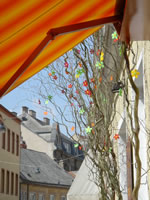
I'm almost finished formatting my pics from Vienna, but here are a couple of my favorites in the meantime. On the left, an awning and tree outside a shop near Schönbrunn. On the right, one of the schmetterling from the Schmetterling Haus.
Update: The photos are up, lame captions notwithstanding.
 
10:18 AM
: link : 0 comments

Comments

Post a Comment      Hide Comments

Wikipedia authorship visualization

When Wikipedia (an online encyclopedia that anyone can edit) first began, some feared that it would be "a recipe for authorial anarchy" or that the "Internet lunatics [would] stumble upon [it]," (both from this NYTimes article), but it has pluckily proven that, in some settings, people with disparate opinions of the truth can reach a neutral consensus. Just as fascinating as the articles themselves is the process of authorship: the constant revision, vandalism, and contention that anneal these articles. Wikipedia offers a tabular revision history, along with "talk" pages for content discussion, but an impression of the overall motion of this collaborative animal is more elusive.

Fernanda Viégas, Martin Wattenberg, and Kushal Dave astounded a packed CHI session last Thursday with their extremely elegant history flow visualization tool. Entry persistence, additions, and deletions are color-coded by author, and can be spaced equally or over time. Anonymous contributors are gray. Mass deletions (such as when the Microsoft entry was replaced with "sucks") appear as solid black lines, and are generally repaired by other Wikipedians within two minutes. (Perhaps someone was going through a bad breakup when he deleted the "Love" entry). My favorite is the zigzag pattern from "edit wars" (see page 6 of Viégas's paper). In this image, two people battled over whether a "chocolate coulage" was a real thing, and you can almost hear them saying, "Nuh uh!" "Ya huh!"

On a related note, my UNC friends, Abe Crystal and Jesse Wilbur are devising system ("Who's My Daddy?" pdf) for wiki content authors to provide hierarchical information, as well. (Wikipedia doesn't allow people to create subpages in the main encyclopedia, but user-contributed structure would be really helpful in other wikis.) In this system, users vote on the best "parent" for a given page, and the one with the most votes appears in the breadcrumbs at the top. While a single-parent hierarchy might not be applicable in all wikis, it's a good start to the concept of distributed information architecture. The boys also get bonus points for their use of acronyms.

May 05, 2004 : 1:18 PM
: link : 0 comments

Comments

Post a Comment      Hide Comments

Human interruptibility
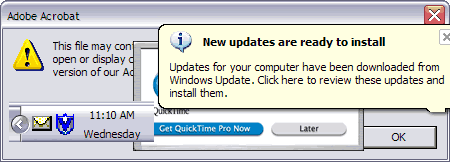
As designers of computer systems, we want our products to be helpful, efficient, and customized to our users' needs. So, we build in functionality for dialog boxes, audio status cues, and instant communication between remote users. But we run the risk of making these machines yipping puppies, constantly querying users whether they want to update to the latest software version, check their new mail, or scan for viruses right now. The critical factor is no longer technological capacity, but rather human ability to pay attention to a task amidst the myriad interruptions we get.

Which is why I'm especially impressed with James Fogarty, Scott Hudson, and Jennifer Lai's research on human interruptibility (here's their most recent CHI paper). Their work looks for ways to predict whether "now is a good time" for an interruption based on a handful of factors, such as phone use, whether the door is cracked, or the presence of another person in the room. Their model is more powerful than the average human guesser, even with the most intrusive sensors (camera and microphone) removed. And it appears to translate well across different kinds of workers, such as highly social managers, focused programmers, and interns in shared offices. I'm curious to see how well it could be applied to workers in different countries, or to people who don't use computers as their primary tool, such as traditional artists. Given the model's already-proven flexibility, I wouldn't be surprised if it continued to excel, as long as it were fed a little extra training data for these diverse groups.

Additionally, the paper wisely indicates that people's opinions of interruptions are relative, both for the interrupter and -tee. An automatic sensor system shouldn't unconditionally prevent all incoming alerts at "bad times;" instead, it should allow the requester to choose whether to leave a message or to continue through. Then you get into the infinitely more difficult research area of ego and politeness, which we'll leave to the sociologists.
May 04, 2004 : 1:55 PM
: link

CHI 2004: My talk

As promised, here are my CHI 2004 slides and accompanying paper. The topic is: "Banner Ads Hinder Visual Search and Are Forgotten." Not that I expect any advertisers to listen, but a girl can hope.

PDF (4 pages, 214K) and Slideshow (non-editable, 1.2M)
May 02, 2004 : 8:32 PM
: link : 1 comments

Comments

Did you do look at whether the partipants remembered any of the /names/ of the companies advertised, versus their actual banners?

I suppose exact banner memory should be > jist memory, but still, the whole marketing 'users must see this at least 3 times before they'll remember it' adage pops up in my memory.

Interesting study :)
posted by Blogger Kevin : November 14, 2005 1:09 PM : link to this comment  
Post a Comment      Hide Comments
About
Moira Burke

Psst! This is the blog of Moira Burke, a Ph.D. student in the HCI Institute at Carnegie Mellon University.

Rife with derivative pop culture blather, this site occasionally features thoughts on social psychology, usability, aesthetics, and the general meanderings of someone figuring out the meaning of life. Won't you help me find it?

my first name @ this domain name

Archives