Skip over navigation
home research portfolio résumé photos reading listening

thoughtcrumbs : january 2005

Postcard offerings to the gods of anticipation

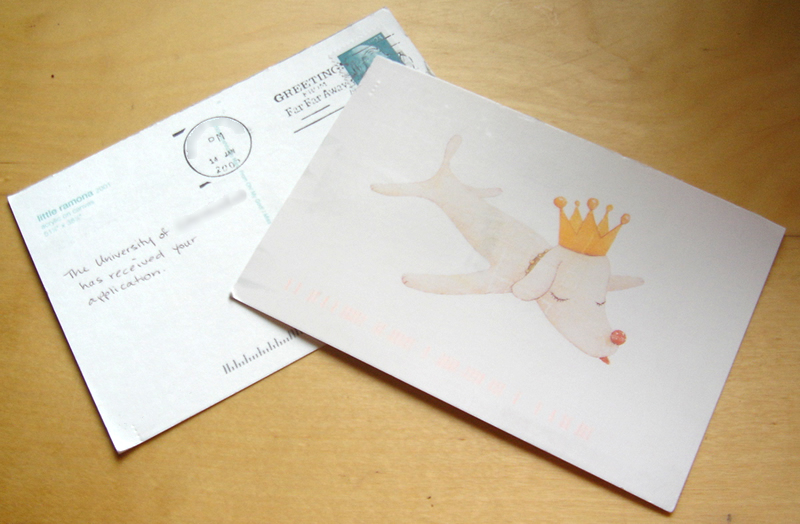
With each of my grad school applications, I included a postcard for the department to mail back to me, letting me know they'd received it. Each letter of recommendation had a postcard tucked inside, as well. The cards were a cute, if slightly disturbing, matching set by Yoshitomo Nara, and I handwrote each one with my lucky Google pen from Vienna.

The last postcard just arrived, and I now have a little shrine in my kitchen window.

Postcards hanging in the window.The University of . . .  has received your application.
January 31, 2005 : 1:06 PM
: link : 0 comments

Comments

Post a Comment      Hide Comments

Gadget lust: waterproof mp3 player

My inner multi-tasker is in a state of euphoria: Imagine listening to audiobooks while swimming laps with this underwater mp3 player. Hopefully the waterproof case will also protect it from my drool.
January 27, 2005 : 4:06 PM
: link : 0 comments

Comments

Post a Comment      Hide Comments

Powell's schoolbook challenge

Everybody's favorite bookstore, Powell's, is trying to put 50,000 books in Portland and Beaverton school libraries. Pledge one book for $5.95 (online, even!) and Powell's will match it with ten more books. That's right, eleven books for the price of two mochas. You didn't need the caffeine anyway.
January 26, 2005 : 11:56 AM
: link : 0 comments

Comments

Post a Comment      Hide Comments

TiVo and iPod encourage fetishism and anti-social behavior

In "The Age of Egocasting," Christine Rosen suggests that TiVo and the iPod have two detrimental effects on society:
  1. They make us lazy samplers of art rather than patient critics. Downloading single tracks rather than entire CDs prevents us from understanding songs in their greater context (complete with B-sides and liner notes). In a Weekend Edition interview, she says:
    Art, literature, and music are supposed to transform us, take us beyond what we think we know and believe. If we're choosing only the things that already endorse what we believe, how will we have the possibility of discovering new things? A lot of these things encourage fetish rather than truly critical appreciation because they don't challenge us.
    and
    With experience and patience comes considerable reward--the disciplined listener eventually achieves a different understanding of the music, when heard as its composer intended. Listening to "Mahler's Greatest Hits" is not the same thing. Sampling is the opposite of savoring.
  2. They decrease our awareness of and willingness to participate in the world. By wrapping ourselves in our own personal entertainment spaces (with iPod earphones or a cell phone), we close ourselves to interactions with others:
    Because the iPod is a portable technology,it has an impact on social space that TiVo does not. Those people with white wires dangling from their ears might be enjoying their unique life soundtrack, but they are also practicing "absent presence" in public spaces, paying little or no attention to the world immediately around them.
Update: Adam had something to say about this.
January 24, 2005 : 8:50 PM
: link : 0 comments

Comments

Post a Comment      Hide Comments

Information and the quality of life

Last week at Online Northwest, David Levy of the UW Information School addressed society's increasing emphasis on instant information: how we tether ourselves to technology and, consequently, to work, without allowing time for quiet contemplation and reflection. Last May, he organized a conference on "Information, Silence, and Sanctuary" which included discussions, panels, and scheduled meditation. Plus, a giant paper mural participants constructed by cutting out an artist's design. Levy described it as "like kindergarten, but with x-acto knives."

Levy also discussed Josef Pieper and the philosophical values of ratio (logical reasoning, searching, abstracting) and intellectus (simply looking, reflecting). Levy proposes technology often facilitates ratio without supporting intellectus (though there are exceptions).

UO librarian (and blogger) Jon Jablonski pointed out that many of the adjectives describing ratio seem text-centric, while those for intellectus are often environmental, descriptors of place. Levy pointed out the practice of lectio divina: slow, contemplative reading of scripture, without analytical thought--a kind of intellectus reached through text.

This dichotomy reminds me of Don Norman's discussion of positive and negative affect in Emotional Design. Aesthetically pleasing objects stimulate positive affect, making users more open-minded to compromise (such as my willingness to forgive blurry pictures from my stylish camera), while negative affect (stress, focus) assists with concentration, making us efficient problem solvers. Technology supports both, providing task-oriented functionality (ratio, negative affect) and rich, immersive experiences (intellectus, positive affect), though integrating the two is a challenge for any good designer.

1:39 PM
: link : 0 comments

Comments

Post a Comment      Hide Comments

UO art museum reopens, sans goldfish

Oh frabjous day! After four long years of renovation, the art museum at the University of Oregon has reopened. One of my favorite contemplative spaces on campus, the museum had a courtyard and koi pond. I remember a day I was particularly appreciative of the quiet space, having been stood up for a coffee date, and so I sat on a bench in front of a twenty-foot mural for an hour, people-watching. I felt a little, well, betrayed when the museum closed my senior year. Funny how they can overhaul the football stadium in a summer, but the museum renovation excluded an entire generation of students.

One hundred twenty-six Andy Warhol pieces will be on display through May 1. The spring MFA exhibit is usually spectacular, as well.

January 23, 2005 : 8:49 PM
: link : 0 comments

Comments

Post a Comment      Hide Comments

E-bake sale

To supplement her income after a divorce, one woman is selling boxes of homemade cookies on eBay. She'll mail a variety of treats for all of the major holidays for $100.

From the NYTimes article:
Though it might seem unusual to commission cookies from a stranger, on the eBay scale of oddity, it ranks pretty low.
So, I tend to cook elaborate dinners multiple times per week and always have a lot of leftovers. Last night was red lentil soup with lime and quinoa, and there is a good gallon still in my fridge. Maybe I should Craigslist it. (Cookie story from Mighty Girl.)
January 20, 2005 : 2:08 PM
: link : 0 comments

Comments

Post a Comment      Hide Comments

Upcoming local HCI events

  • CHI 2005 local events planning. Tonight, 8-9pm, HCI lab at Lewis & Clark.
  • Internet-based storytelling. Jim Miller, Miramontes Computing. CHIFOO lecture, Wednesday, Feb 2, 7:30pm, Tektronix.
  • From blogs to wikis. Michael Lee Squires. IPN lecture, Tuesday, Feb 8, 6pm, OHSU Old Library Auditorium.
  • Increasing universal benefit from information technology. Melody Ivory-Ndiaye, UW iSchool. CIS colloquium, Thursday, Feb 17, 3:30pm, 220 Deschutes Hall, University of Oregon.
January 19, 2005 : 5:40 PM
: link : 0 comments

Comments

Post a Comment      Hide Comments

Existential plea of a Wikipedian

Continuing the Wikipedia authority discussion of last week: Should living people be included? Wikipedia has suggested criteria for biographies, but individual entries are still disputed.

Christina Wodtke, a well-known information architect (about whom I've spoken before), has been added to Wikipedia, but is fighting deletion. She is requesting to be saved on her blog.

January 18, 2005 : 9:01 PM
: link : 0 comments

Comments

Post a Comment      Hide Comments

The news is all "Ice! And Terrorism!"

An ice storm hit Portland last night, and since we metropolites lack the hardy constitution (and, apparently, de-icer) found to the east, we're pretty much homebound. The TV news has declared a weather emergency requiring levels of coverage normally reserved only for terrorism and the Golden Globes. And ORBlogs has some great posts about the storm.
January 15, 2005 : 4:41 PM
: link : 0 comments

Comments

Post a Comment      Hide Comments

Colin Meloy at the Doug Fir

Cutie chanteur Colin Meloy (Decemberists) played a solo show at the Doug Fir last night, filling the stylishly timbered lounge with the songs his bandmates won't let him play. Turns out those happen to be my favorite Decemberists songs: Shiny, The Bachelor and the Bride, The Gymnast; the ones with gorgeous chord progressions best suited to acoustic guitar uncluttered by other instruments. Meloy remarked that the solo tour reminded him of his early Portland performances, "if each of you represented 0.06 of yourself, and collectively formed the bartender and a cocktail waitress. And maybe a drunk guy." He also promoted his upcoming album, Picaresque, which the guy standing behind me defined as "all about Captain Picard. You just drop the 'd.'"
4:22 PM
: link : 0 comments

Comments

Post a Comment      Hide Comments

CHI 2005 planning meeting

Portlanders interested in planning CHI 2005 events should contact Erik Nilsen. The group will meet next Wednesday from 8-9pm in his lab at Lewis & Clark College to discuss local tours, restaurants, etc. It's rumored that this year's activities will include "go out to lunch with a local." I can't wait to take a group over to Lovely Hula Hands.

Other restaurant suggestions? Email me.

January 14, 2005 : 12:49 PM
: link : 0 comments

Comments

Post a Comment      Hide Comments

Social health of older adults

Last night's CHIFOO meeting was one of the better ones from the last few years. Jay Lundell and Margie Morris from Intel's Proactive Health Lab discussed ways technology could support the sociological health of older adults. Numerous longitudinal studies indicate that social connectedness improves general health, and yet that connectedness declines with age. Intel's participants reported having trouble remembering friends' names, so they would avoid social situations rather than risk embarrassing themselves. (Hey, I do that, too!) Though lauded as the ultimate tool to combat loneliness, computers tended to be in isolated rooms, and were difficult for participants to use.

The researchers provided hardware displays designed to provide feedback about social interactions: a line graph representing time spent with others, a "solar system" of friends that expanded over time, and some bar charts. Not surprisingly, though, the participants preferred a "simpler" gadget: a lamp that illuminated when their children were home (at their own houses). Nothing fancy, just an old-fashioned lamp reminding them that someone was thinking of them.

January 13, 2005 : 5:27 PM
: link : 0 comments

Comments

Post a Comment      Hide Comments

Un-library-like outbursts of song

Prangstgrüp's library musical will have you humming "We're reading on a dream . . . reading on a hell of a feeling!" all afternoon. Paul Musgrave attributes this outrageous flouting of proper library behavior to the media, "with their endorsement of the Singing-American lifestyle."
January 11, 2005 : 5:16 PM
: link : 0 comments

Comments

Post a Comment      Hide Comments

ISBNs move to 13 digits

NISO, in the cheerily-punctuated article "Get Ready for the New ISBN!," announces that ISBNs will be three digits longer beginning in 2007. Library software vendors are hard at work looking for ways to charge us for the conversion.
11:19 AM
: link : 0 comments

Comments

Post a Comment      Hide Comments

Excellence in teaching: The Reese's Puffs method

How to make a lecture hall full of intro biology students pay attention at 9am? Hand out sugary cereal. At least that's what my little brother's professor did. Holding up a box of Reese's Puffs, he said that he'd eaten them for breakfast, and invited those who'd just rolled out of bed to take a handful. He proceeded to describe the macromolecules (i.e., proteins) inside. And class was dismissed before the sugar crash set in.
January 10, 2005 : 7:07 PM
: link : 0 comments

Comments

Post a Comment      Hide Comments

Wikipedia authority

Lots of discussion recently about Wikipedia, particularly its inherent authority. Clay Shirky created a script to post "dashboard" metadata at the top of a Wikipedia entry: number of edits, number of editors, first edit date, and most recent edit date. At Many-to-Many, he discusses how these factors indicate the value of the entry, and stresses that Wikipedia is a process, not a product.

Matt Jones suggested adding a sparkline infographic ("data-intense, design-simple, word-sized graphics" --Tufte) showing revision history. Perhaps using a version of Viégas and Wattenberg's history flow tool, which I've discussed before.

Additionally, danah boyd explains some differences between vetted encyclopedias and Wikipedia, reminding us that open source reference allows for equal opportunity for contribution, not equal quality between entries.

Wired also has a story today about scaling and authority.

2:38 PM
: link : 0 comments

Comments

Post a Comment      Hide Comments

Library account RSS feed

Yesterday 43 Folders asked LazyWeb if someone could build an RSS feed for overdue library books. Merlin writes: "The respect and admiration of lazy, penurious nerds everywhere shall be your laurel."

One of the commenters brought up LibraryELF, which fits the bill nicely. Let's hope this publicity encourages more libraries to join. The library where I work joined last month, and the developers were great about troubleshooting catalog quirks with me. Sadly, no other Portland-area libraries are members yet. Come on, Multnomah County!

January 07, 2005 : 10:08 AM
: link : 1 comments

Comments

The Ann Arbor District Library in Michigan just turned on RSS feeds a la Merlin's suggestion - see some of them at http://www.aadl.org .
posted by Blogger Edward Vielmetti : July 15, 2005 11:32 PM : link to this comment  
Post a Comment      Hide Comments

Flickr in numerical order

Really clever collaborative photo series at Flickr: The In Numerical Order pool. They're at 130 as I type this. My favorites: 34, 46, and 109.

A bit like the human clock.
January 06, 2005 : 8:35 PM
: link : 0 comments

Comments

Post a Comment      Hide Comments

A nun's perspective on web communities

Joan Chittister, a Benedictine nun, describes her gradual embrace of the Internet as a medium of social change. Though initially wary of advertising and privacy issues, she was surprised by the potency of online communities like MoveOn.org and the ease of organizing social justice discussions. She says:
I've seen the Internet's power to organize large crowds of people, seemingly out of nowhere, to do anything anywhere at anytime together -- a kind of "do it yourself" mob scene technology.
But also:
The Internet carries within itself the quiet power to organize the whole world into one great thoughtful colloquy.
It's nice to be reminded.
6:19 PM
: link : 0 comments

Comments

Post a Comment      Hide Comments

The very best Christmas present

From my mom: A couple of branches from her daphne shrub. They're blooming on my kitchen counter. Daphne smells like optimism.
January 05, 2005 : 8:03 PM
: link : 0 comments

Comments

Post a Comment      Hide Comments

Mobile community conference and journal listings

New at Mobile Community Design: A database of conferences and journals relating to mobile, collaborative, and social networking topics. It's sortable by conference date and submission date, and indicates whether they're peer reviewed. The database is, of course, collaborative, so anyone is welcome to add items. Jeff Axup, the database's designer, has also been very gracious about my nitpicky CSS suggestions. (If you make it here for CHI, Jeff, drinks are on me.)
4:56 PM
: link : 0 comments

Comments

Post a Comment      Hide Comments

CHIFOO resumes next week

CHIFOO's theme this year will be "Imagination to Transparency: Ubiquitous Computing Comes of Age," and the first meeting is next Wednesday. Jay Lundell (Intel Proactive Health Research) will present an ethnographic study of the morning routines of older adults, especially those with cognitive challenges. Other topics in the series include public WiFi initiatives, online storytelling, and glance-able displays.
January 04, 2005 : 8:42 PM
: link : 0 comments

Comments

Post a Comment      Hide Comments

Hypertext tricks

Today's Alertbox focuses on advanced hypertext: rethinking the way links work. The article is mostly a wish list of browser features and design conventions, but a surprising number have been implemented or researched. (A few more than Nielsen mentions.)
  • Fat links: Open more than one page at a time. No HTML syntax exists for this yet, though the LookAhead extension to Firefox opens Google results in multiple tabs. (Which actually seems like a hassle, since I have to close all of those tabs with results I don't want .)
  • Explicit IA: Providing standardized (browser built-in) buttons to structural site pages (home, site map, help) to reveal the underlying information architecture. This can already be done with the <link> tag's rel attribute, providing support to users with disabilities. The iCab browser has built-in buttons beneath the URL bar, and there's also a Firefox extension for this.
  • Integrated searching and linking: Letting people type in task-based keywords and then displaying a relevancy score next to the links on a page as the user browses around. A lot of researchers are investigating how to intuitively convey this "information scent."
Along with Penn State's active learning browser, Nielsen's article promotes building support for common user activities right into the browser, rather than relying on individual site designers to follow standards. I hope this shift continues.

Update: Eric Scheid pointed out that iCab also supports something similar to what Nielsen calls typed links (though a better name might be link hinting): the hand cursor changes to a hand with a mini page icon if the link opens in a new window. Nielsen mentions indicating when links go to external sites, which he himself implements well with the <a> tag's title attribute. Hover over links in his article to see the link title, which includes the name of the destination site.

January 03, 2005 : 2:31 PM
: link : 0 comments

Comments

Post a Comment      Hide Comments

Gestapo geek squad

NPR had a story this morning on "geek squads" deployed by consumer electronics retailers to do in-home installations. For a lot of people (and I'm thinking of my parents here), paying someone do the initial setup and give some training provides a much-needed measure of comfort and confidence not instilled by the product manual. However, one woman's comments shocked me: a college student taking network administration courses was basically bullied into the service at Best Buy. "I didn't think I could do it by myself. They kept saying how someone would hack into my credit card." Intimidating customers and reducing their technological confidence should not be part of the package.
11:35 AM
: link : 0 comments

Comments

Post a Comment      Hide Comments
About
Moira Burke

Psst! This is the blog of Moira Burke, a Ph.D. student in the HCI Institute at Carnegie Mellon University.

Rife with derivative pop culture blather, this site occasionally features thoughts on social psychology, usability, aesthetics, and the general meanderings of someone figuring out the meaning of life. Won't you help me find it?

my first name @ this domain name

Archives